








Scheduled flag changes
Contents
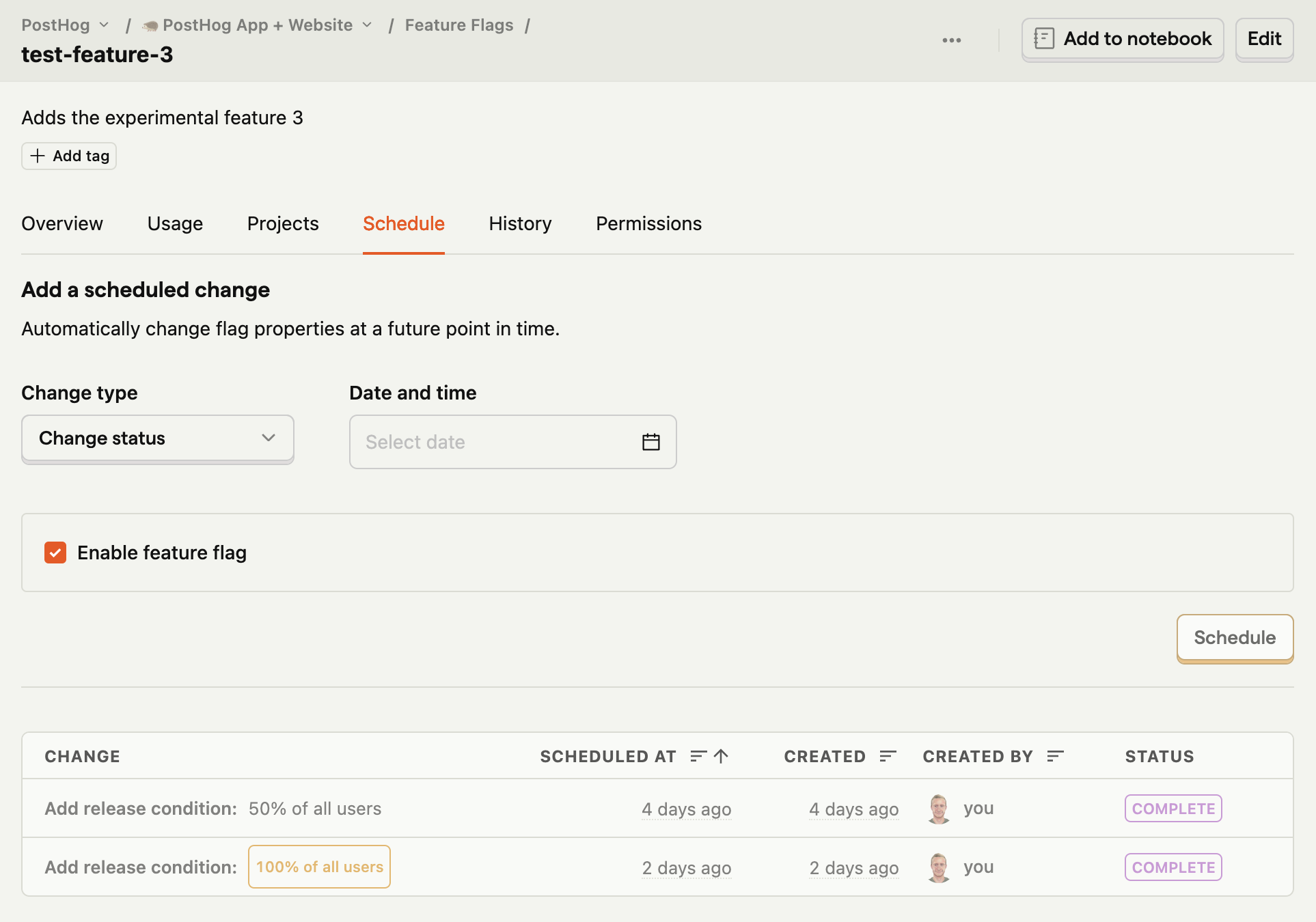
Scheduling feature flag changes enable you to automatically change flag properties at a future point in time. For example, you can schedule an initial release of a flag for internal testing, then enable it to the beta users group 2 days later, and finally, roll it out to 100% of the users in 2 weeks.
This is also useful if your releases fall outside normal working hours. For example, a ticket sale starting at midnight.
How to schedule a change:
- Navigate to the relevant feature flag.
- Select the Schedule tab.
- Under Change type:
- Select Change status to enable or disable your flag at a scheduled time.
- Select Add condition to append rollout conditions to your flag at a scheduled time.
- Select Update variants to update the variant keys, descriptions, payloads, or rollouts.
- Select the Date and time of your scheduled change using the date picker.
- Optionally, use the Repeats dropdown to set a recurrence interval (daily, weekly, monthly, or yearly). When a repeat interval is selected, an Ends date picker appears to set an optional end date for the recurring schedule.
- Click Schedule.
Scheduled changes appear below the form, grouped into an Active & upcoming section and a collapsible History section.
Recurring schedules
Recurring schedules repeat a scheduled change at a regular interval. You can choose from daily, weekly, monthly, or yearly recurrence and optionally set an end date.
Recurring schedules are supported for the following change types:
- Change status – toggle the flag on or off on each recurrence
- Update variants – replace the variant configuration on each recurrence. Each run overwrites the previous variant setup, so any manual changes made between runs are replaced.
Recurring schedules are not supported for the Add condition change type because it appends a new condition on each run, which creates duplicates.
Copy scheduled changes across projects
When copying feature flags across projects, you can optionally include pending scheduled changes. This is useful when you want to replicate your entire flag configuration, including future automated changes, to another project.
When copying schedules:
- Only pending (unexecuted) scheduled changes are copied
- All schedule properties are preserved, including timing, recurrence, payload, and end dates
- Schedules that have already executed are not copied to avoid duplicating completed actions
To copy schedules, check the Copy schedules option in the Projects tab when copying a flag. The checkbox shows the number of pending schedules available to copy.